It’s the year 2026, and Red Dead Redemption 2 continues to ride tall in the saddle of gaming culture, refusing to be forgotten like a dusty old outlaw yarn. The open-world cowboy epic from Rockstar Games has not only held its ground against a stampede of newer AAA titles but has also infiltrated the most unexpected of frontiers: a college assignment. One brave student recently decided that a dry political analysis paper was crying out for the philosophical musings of Dutch van der Linde—and the internet, naturally, lost its collective mind.
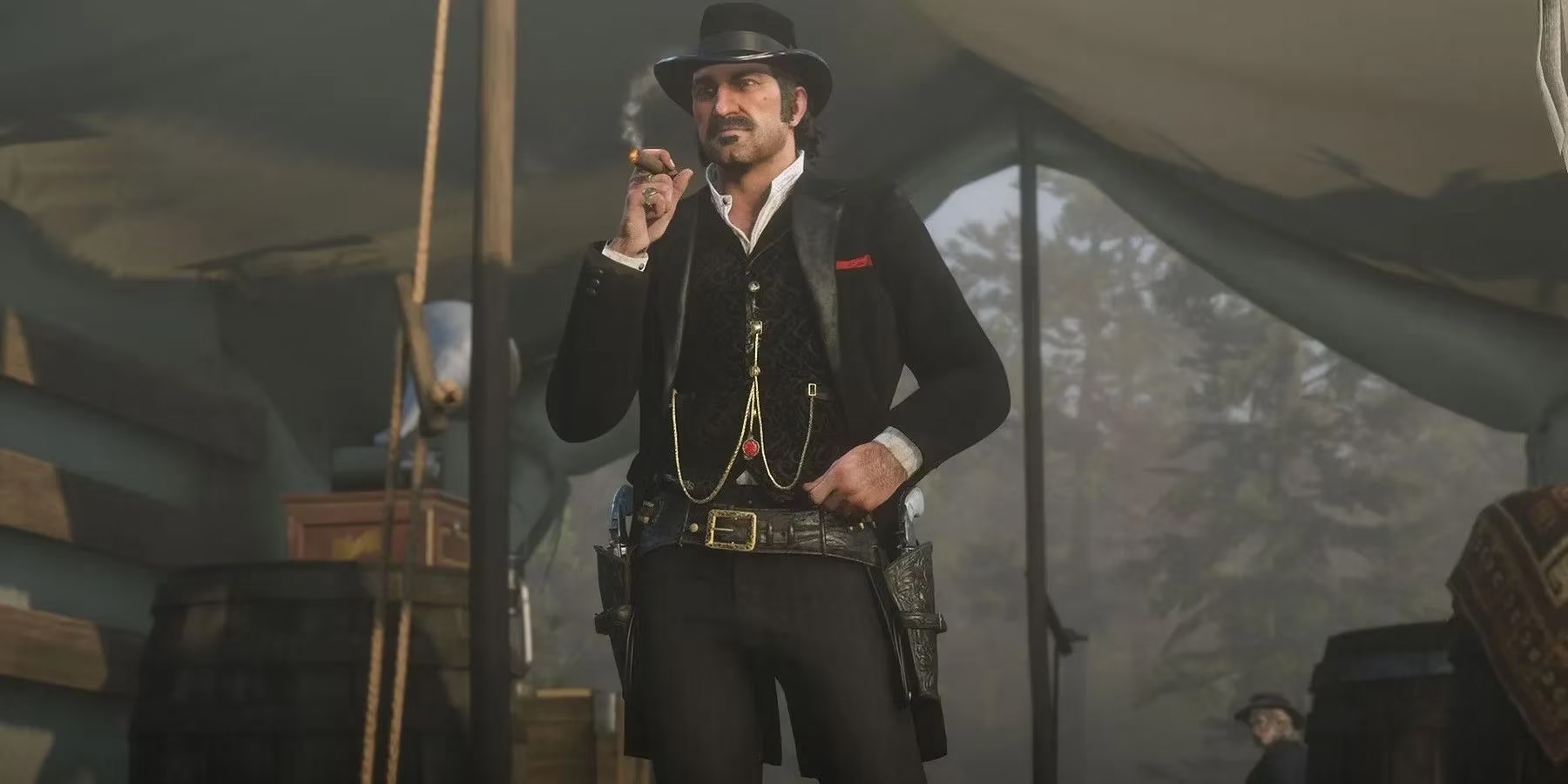
The tale begins on a quiet corner of Reddit, where user Immediate_Fox1930 shared a snippet of their academic handiwork. Tucked between serious paragraphs about modern governance was this gem: Dutch van der Linde’s warning about greed devouring a person’s very soul. The student—clearly a card-carrying member of the Van der Linde gang in spirit—drew a thread from Dutch’s grandiose speeches to the tangled web of real-world politics. It was the kind of move that makes you wonder: did the professor catch the reference, or did they just nod along, thinking it was some obscure political theorist? Oh, the delicious ambiguity.
Let’s back up a moment for those who haven’t spent 50-plus hours roaming the heartlands. Dutch van der Linde is the charismatic, increasingly unhinged leader of the gang, a man whose silver tongue can spin chaos into poetry. One of his standout lines—the very quote that wormed its way into academia—goes something like: “We all get obsessed with greed. So obsessed with some... idea of getting rich, that we forget the people we’re steppin’ on to get there.” It’s a dagger wrapped in velvet, and apparently, it doubles as half-decent political commentary. Who knew?
The Reddit post quickly became a campfire gathering for gamers who saw a bit of themselves in this cheeky academic sabotage. Some applauded the seamless fusion of gaming passion and education, picturing the student grinning like a cat in a creamery while submitting the paper. Others? Well, they focused on the less poetic details. Bless their eagle-eyed hearts, more than a few commenters couldn’t resist pointing out that the student had, in fact, misspelled “Dutch van der Linde.” (It was written as “Dutch van der Lind” or some similarly tragic typo.) The thread erupted in good-natured roasts, one user quipping, “Dutch van der Linde? More like Dutch van der Limb-o, because that spelling just limped right off the page.” Talk about a mic drop moment.
But let’s not let a typo steal the spotlight from the bigger picture: the enduring gravitational pull of Red Dead Redemption 2. Even in 2026, the game’s characters strut through pop culture like they own the place. Arthur Morgan’s gruff wisdom, Sadie Adler’s fiery resilience, and yes, Dutch’s tangled philosophies still echo in forums, memes, and now, apparently, undergraduate essays. This isn’t just a game; it’s a goldmine of quotable moments. One Redditor chimed in with Arthur’s famous line: “We’re more ghosts than people,” and suddenly the thread transformed into a virtual campfire where everyone shared their favorite snippets. From John Marston’s laconic wit to Hosea’s weary insights, the comments became a love letter to the game’s writing.
What makes this cross-pollination between gaming and education so delightful is how utterly unapologetic it is. The student didn’t try to disguise the quote as classic literature or a forgotten philosopher’s treatise. They simply lobbed a Dutch-ism right into the middle of an assignment, fully aware that it might sail over the grader’s head—or land with a satisfying thud in a gamer professor’s heart. It’s the academic equivalent of hiding a doodle in the margins, except this doodle packs existential weight about human nature. And honestly, haven’t we all daydreamed about pulling a stunt like this? The sheer cheek of it is enough to make any gamer tip their virtual hat.
Diving deeper, the incident highlights how Red Dead Redemption 2’s NPCs and dialogue are crafted with a novelist’s care. Even minor characters deliver lines that stick to your ribs like a good camp stew. The game’s narrative has sparked real-world academic analysis—podcasts dissecting its themes, YouTube video essays unpacking its morality, and yes, students using its quotes to underscore political arguments. It’s not a stretch to say Dutch’s dialogue could hold its own in a philosophy syllabus. The man talks about loyalty, freedom, and corruption with a theatrical flair that would make Machiavelli blush. And yet, here we are, giggling over a misspelled name.
Speaking of that misspelling, let’s give credit where credit is due: it added an extra layer of accidental comedy. If Dutch van der Linde ever found out, he’d probably launch into an impassioned monologue about betrayal and the decay of literacy while subtly blaming Arthur for the whole mess. The internet, meanwhile, did what it does best—turning a simple typo into a meme. Someone photoshopped a wanted poster reading “Dutch van der Lind, alias: Speeling Bandit.” Others joked that the student’s paper had “a plan” just like Dutch always claimed, but this plan involved zero proofreading. The ribbing was all in good fun, of course, and the student seemed to take it with humor, proving that even in a fandom as intense as Red Dead’s, a little self-deprecation goes a long way.
The story also underscores a broader truth about the relationship between video games and mainstream culture. Red Dead Redemption 2 refuses to fade into the sunset. Nearly a decade after its release, it remains a touchstone for discussions about storytelling in interactive media. New AAA titles launch with ray-traced fanfare, but none have quite replicated the lived-in, dusty authenticity of Rockstar’s 1899 America. From dynamic horse testicle physics (yes, that was a thing) to heart-wrenching character arcs, the game planted its flag early and deep. Today’s college students—many of whom played it in their formative teenage years—still carry its lessons into unexpected places. It’s a testament to how games can become woven into the fabric of our intellectual and emotional lives, not just our leisure hours.
In the end, this student’s audacious move did more than score a few laughs on a subreddit. It reminded the gaming community that our passions don’t have to stay confined to the screen. They can bleed into our essays, our conversations, and our worldviews. Whether the professor recognized the quote or simply assumed the student had been reading nineteenth-century anarchist pamphlets, the assignment now lives in a kind of hall of fame. And if any academics out there are reading this, go easy on the next paper that quotes Arthur Morgan’s musings on redemption. After all, in the words of a man with a very poor track record of plans, “We can’t always fight nature, John. We can’t fight change.” Change, it seems, now includes video games infiltrating your grading pile. And honestly, that’s a change worth embracing.
Comments