Gaming in 2026 has reached a point where emotional storytelling is just as critical as high-fidelity graphics or responsive controls. Developers now understand that players don't just want to shoot things or solve puzzles—they want to feel something. Over the years, the medium has gifted us with moments of profound joy, blinding rage, and genuine heartbreak. A powerful character death can elevate a game from mere entertainment to a work of art. Yet, for every heroic sacrifice that resonates through the ages, there is a fumble, a narrative misstep where a character's demise leaves players feeling hollow, annoyed, or simply baffled by its lack of impact. These aren't the deaths that fans mourn because they were so well-written; these are the deaths that became infamous because, in the grand scheme of the story, they ended up being completely pointless.
It’s a delicate balance, really. Writers must justify a character's removal from the board, ensuring that the narrative void created actually means something for the survivors. When it works, it’s unforgettable. When it fails, it sparks endless debates on forums and social media, with fans dissecting exactly where the logic crumbled. Sometimes, a future sequel or a retcon can cheapen a past sacrifice. Other times, a death is so obviously avoidable that it only serves to make a previously intelligent protagonist look foolish. Let's dig into some of the most egregious examples where a character took their final bow, and the audience collectively asked, "Wait, what was the point of that?"
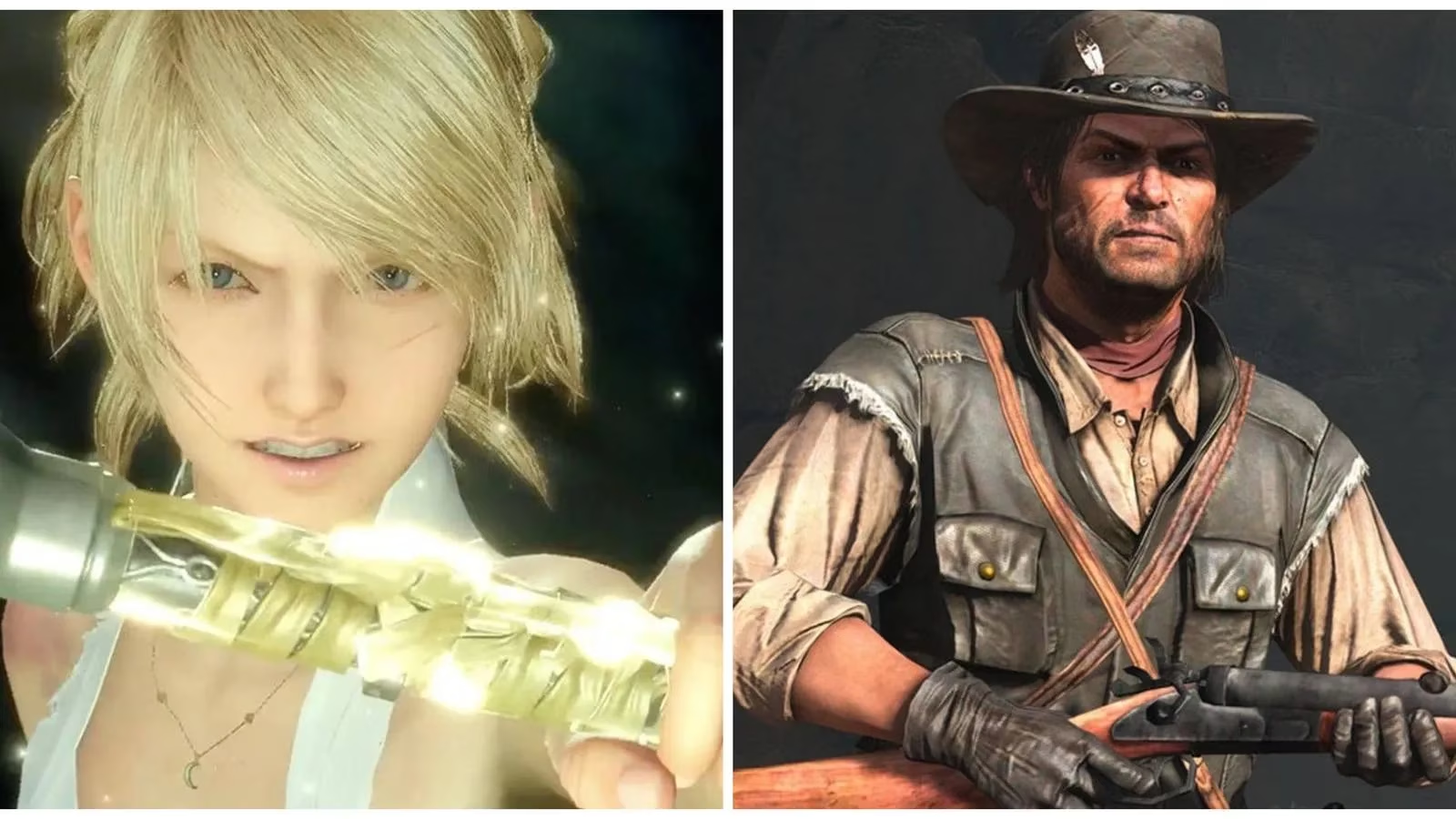
Take the case of Lunafreya in Final Fantasy 15. The development of that title was famously a long, winding road, and Hajime Tabata was handed the unenviable task of stitching together something coherent from years of fragmented concepts. The result was a road trip adventure that resonated deeply with some, but it left the relationship between Noctis and Lunafreya in a bizarre, undercooked state. The game kept insisting that their bond was the emotional core of the story, yet players barely witnessed them interact. When she met her end during the chaos in Altissia, the moment was visually spectacular but emotionally flat. One couldn't help but wonder why we were supposed to be devastated over a connection we were merely told about, not shown.
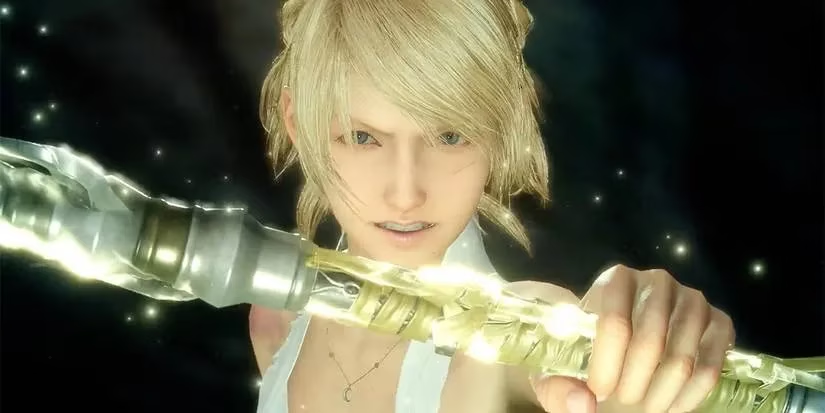
What made the aftermath feel even more hollow was Noctis’s reaction. Instead of a period of grieving that felt nuanced, his immediate behavior came across as a whiny spiral, particularly when he appeared to ignore the far more immediate, physical trauma suffered by his friend Ignis, who lost his eyesight. It warped the hero’s journey into something awkward. Had Luna been given dedicated story chapters to build her presence, her agency, and her chemistry with Noctis, her death might have been a legendary gut-punch. Instead, it stands as a testament to a production that just didn't have enough time to earn the tears it was asking for.
A completely different flavor of pointlessness, but one that is thematically intentional, comes from Red Dead Redemption. Everyone who played John Marston’s harrowing tale remembers that barn door opening. After doing everything dutifully for the government agents who blackmailed him, John finally thought he had bought his family’s peace. Instead, he was treated to a firing squad. It’s a horrid, messy death that offers no final stand in a heroic blaze of glory, just a man being gunned down like an animal, executed to cut a loose thread. This isn't a narrative mistake; it's a commentary on how the civilized world had no room for someone with John’s past, no matter how hard he tried to reform.
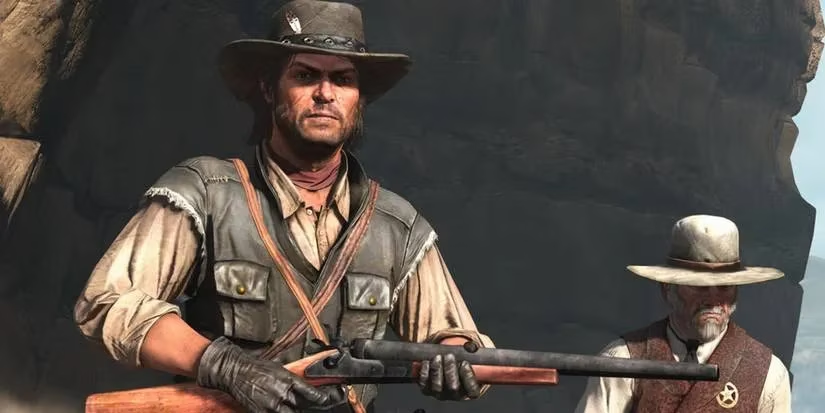
From a purely narrative satisfaction standpoint, it feels brutally meaningless. A player fights so hard for survival only to be inevitably mowed down in a scripted sequence. There is no escape, no dialogue skill check to pass. But that’s precisely the point the writers wanted to convey: the crushing futility of trying to outrun a system that sees you only as a problem to be solved. It's a death that serves a philosophical purpose, even if the event itself is an unceremonious and painful burial of a beloved cowboy.
Futility takes on a far messier form when logic collapses, as seen in BioShock Infinite. Ken Levine’s multiverse adventure dazzled players in 2013 with its floating city of Columbia, the complicated bond between Booker DeWitt and Elizabeth, and a mind-shattering twist. By the end, it’s revealed that to stop the villainous Prophet Comstock from ever existing, Booker must allow himself to be drowned at the point of his baptism, ostensibly pruning every branch of the timeline where he becomes a monster.
But in the years since, players have had plenty of time to dissect the quantum mechanics at play, and the logic has shown cracks. The idea that drowning one Booker at a single, specific baptismal location could erase an infinite spectrum of alternate realities is a stretch that breaks under scrutiny.
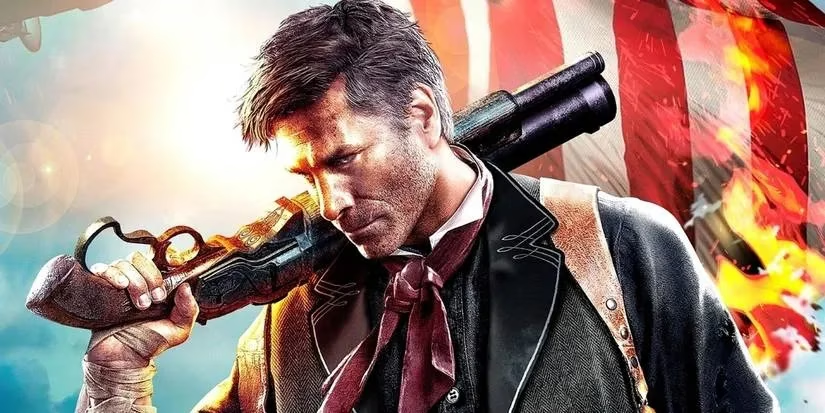
A single constant death cannot logically fix a variable multiverse. There would be countless universes where Booker didn't go to the river that day, or universes where his disposition was already hardened without the baptism. Some clever fans have argued that Elizabeth didn't drown a Booker, but rather used the specific symbolic location to smother the concept of Comstock in the crib. It’s a beautiful metaphorical reading, but if you look at it strictly at face value, it's a sacrifice that feels cosmically pointless, a single death in a sea of infinite possibilities that shouldn't have achieved the desired hard reset.
Sometimes, the illusion of choice makes a death sting even more. Telltale Games taught us that lesson early in The Walking Dead. The first episode presented a frantic choice between saving the nerdy tech expert Doug or the sharp-shooting reporter Carley. It was a classic telltale "This choice will be remembered" moment. For a while, the choice does flavor the dialogue during the next episode, but by the third episode, the script runs out of bandwidth. Regardless of who you saved, they are unceremoniously killed off in the same scene with barely any alteration to the event’s structure. They both die to prove that nowhere is safe, making the life-or-death decision feel utterly cosmetic.
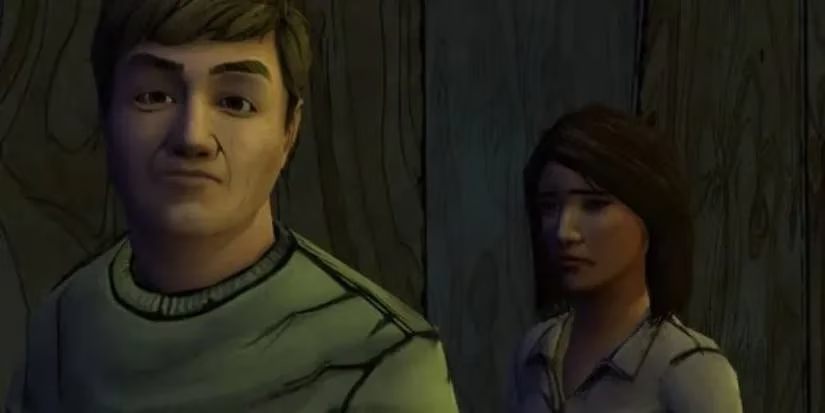
It teaches a harsh mechanical truth: if a character is destined to die, then the resources required to animate and voice two different ongoing story arcs for multiple chapters are often too great for a branching narrative. But knowing that doesn't make the player feel any better for struggling with the choice. It just makes Doug and Carley feel less like people and more like plot devices wearing red shirts, waiting for their number to be called so the grim tone can be maintained.
😢 A quick look at some of history's most hollow deaths:
-
Lunafreya (FF15): A fridged character we never got to know.
-
Booker (Bioshock Infinite): A metaphysical paradox more than a clean fix.
-
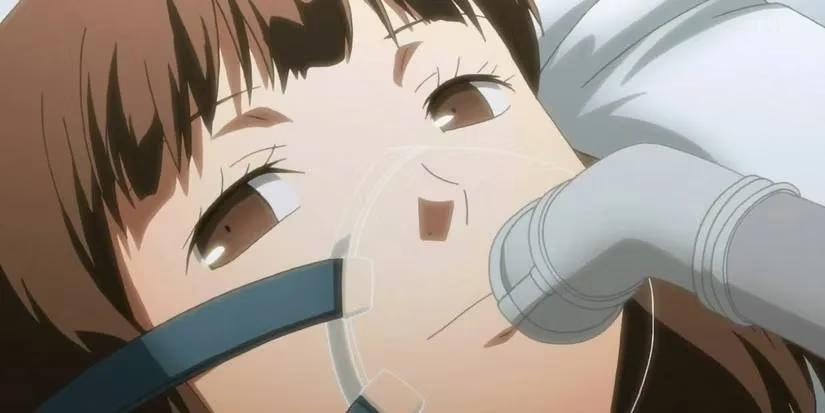
Nanako (Persona 4): A tragedy locked behind a bad ending you can fix.
Nowhere is the concept of a narratively wasteful death more interactive than in Persona 4. The investigation into the Midnight Channel is a murder mystery that eventually leads to a hospital room, where the hero's little cousin, Nanako, clings to life. In a tense confrontation, the group has a chance to exact revenge on the suspect, Taro Namatame, by pushing him into a television to die. If a player's anger gets the better of them and they go through with it, Nanako succumbs, and the game abruptly rolls to a bad ending, hiding its true final act.
Nanako's death in Persona 4 can be seen as the ultimate pointless tragedy because it's a failure state screaming to be corrected. It’s a punishment for the player abandoning critical thinking for base vengeance. The game essentially says, “Want to see something sad and then have a horribly incomplete story? Here you go.”
It’s a brilliant use of player agency to hurt the audience, but in the canon of the game, it’s an avoidable aberration. The "true" path shows her making a miraculous recovery, so a playthrough that ends with her passing is just a timeline where a terrible decision was made for nothing, robbing the investigation of its resolution.
Perhaps the most frustrating way to render a death pointless isn't through bad writing, but through a later entry that retroactively destroys the emotional weight. For years, Final Fantasy 10 was praised for its bittersweet finale. Tidus, the cheerful spirit who helped save Spira, fades away on a pier in a heart-wrenching scene that features a high-five passing through a ghostly hand. It was the perfect catharsis, showing that true loss comes with a quiet, permanent goodbye.
Then came Final Fantasy 10-2. While the dress-sphere adventure had its charms, its true ending proved controversial. Yuna basically wishes hard enough, and through a series of convoluted tasks, manages to revive Tidus completely, giving them a literal fairytale reunion. By pulling this off, the sequel doesn't just resurrect a character; it buries the thematic significance of the first game's sacrifice. It suggests that the intense emotional maturity of letting someone go was just a temporary inconvenience until the magic plot device brought them back.
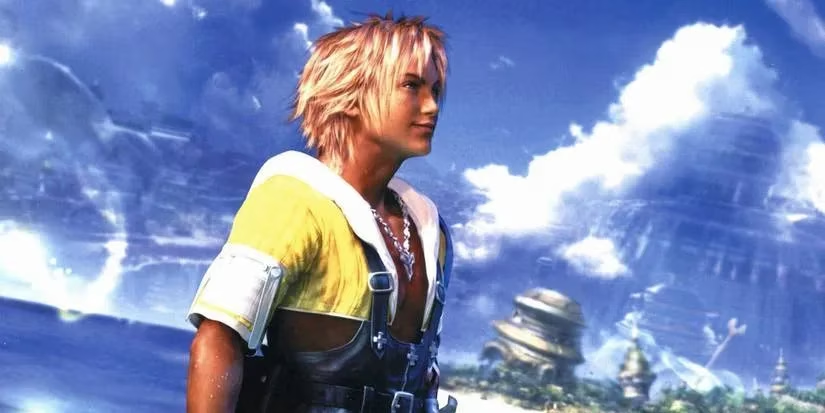
It’s the textbook definition of a pointless death in narrative design, because a magical rewind button means his disappearance never truly had to be a permanent goodbye. For players who spent two decades holding onto that beautiful, painful sunset in Luca, the sequel felt like a cheat code that ruined the finality of the sacrifice.
In the modern landscape of 2026, where generative AI and procedural narratives are starting to allow for truly persistent character deaths, these older examples serve as vital teaching tools. They remind us that a death without consequence is merely a shocking image that fades. Whether it’s a production error, a logical paradox, or a greedy sequel, a character’s end must resonate beyond the screen to truly matter. Otherwise, it’s just noise.
Comments